> ## Documentation Index
> Fetch the complete documentation index at: https://docs.tuneplane.ai/llms.txt
> Use this file to discover all available pages before exploring further.
# Deployments
> Durable internal serving with a stable endpoint, immutable revisions and scoped tokens, at /deployments.
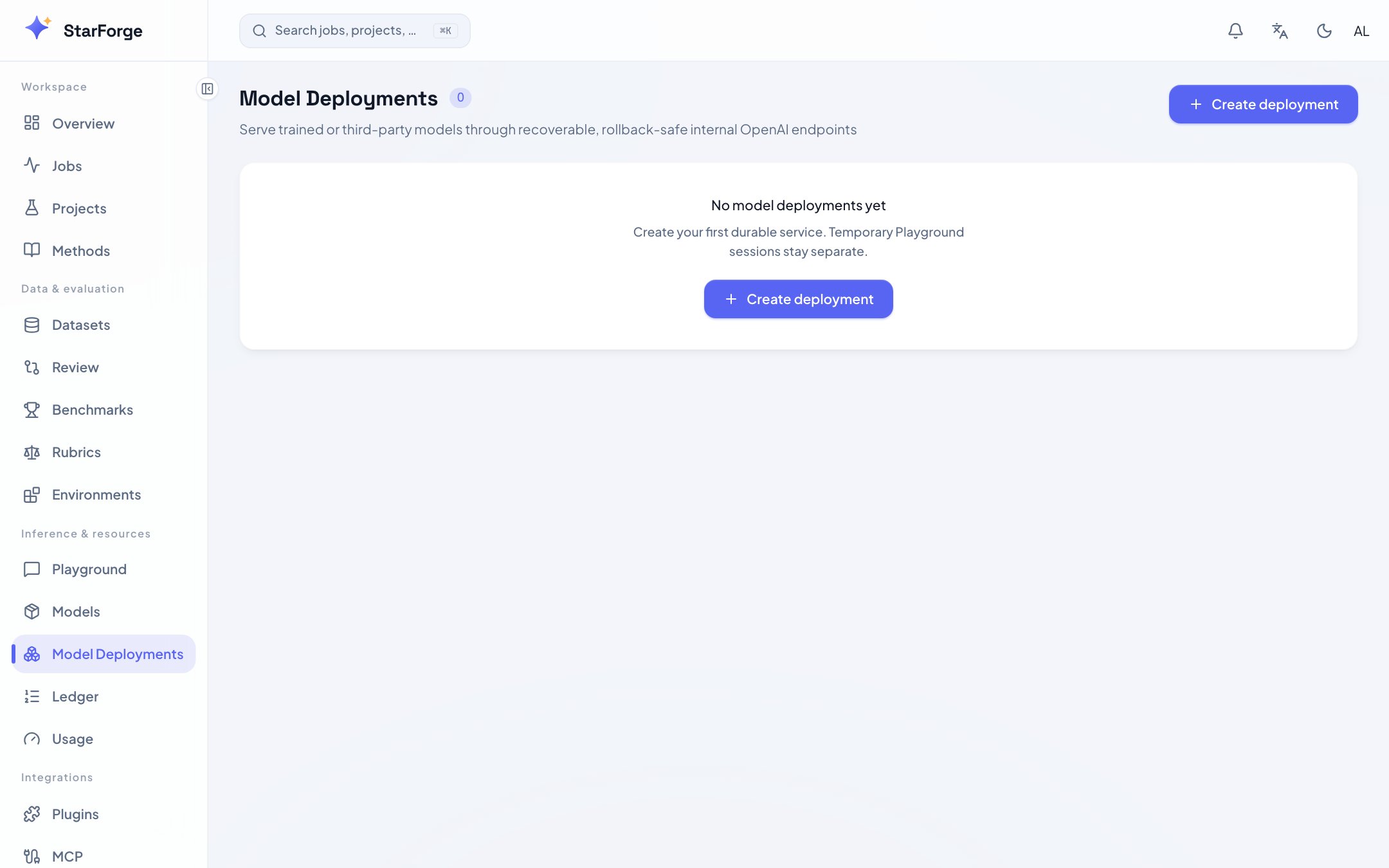
Durable internal serving at `/deployments`, separate from TTL-based
[Playground](/en/console/playground) sessions. Every deployment has a stable endpoint, immutable
revisions and its own revocable tokens. Suspending releases the GPUs and keeps the identity.
 ## Create a deployment
The wizard has four steps: identity, model source, runtime settings, review.
| Model source | Notes |
| ------------------------- | ----------------------------------------------------------------------------- |
| A model registry version | The normal case. Leave the version empty to follow whatever is promoted |
| A run's `hf_export` | Export a plain checkpoint with `tp export` first |
| A Hugging Face repository | A private one uses your own [linked credential](/en/integrations/huggingface) |
| A ModelScope repository | Public repositories only |
| A shared directory | One an administrator has allowed |
Then **vLLM** or **SGLang**, and the settings that shape it: GPU count, dtype, quantization,
context length, concurrency, memory utilisation, and the model name callers send.
Engine-specific fields appear once you pick the engine.
Settings are a typed allowlist. There is no free-form shell-argument field, so nothing you enter
here can become an extra flag on the engine process.
`trust_remote_code` is disabled by default and is available only when an administrator permits it, because it executes code from the model repository.
## Status and recovery
The normal progression is `Deploying`, `Warming`, then `Ready`. Failures use `Degraded` or `Failed`; a paused deployment is `Suspended`. `Ready` means the runtime is alive, health checks pass, `/v1/models` contains the expected alias, and a minimal generation warm-up succeeds.
The controller recreates a lost or repeatedly unhealthy single-replica runtime with bounded backoff. Suspend stops the runtime and releases GPUs; resume recreates it from the current revision.
## Call the stable endpoint
The initial token is shown once after creation. Create, revoke, or rotate additional credentials under **Settings → Deployment tokens**.
```bash theme={"theme":{"light":"github-light","dark":"github-dark-dimmed"}}
curl "https://tuneplane.your-company.com/inference//v1/chat/completions" \
-H "Authorization: Bearer $DEPLOYMENT_TOKEN" \
-H "Content-Type: application/json" \
-d '{"model":"","messages":[{"role":"user","content":"hello"}]}'
```
The detail page's **Playground** tab uses the signed-in web session and never reads or exposes deployment tokens. Client traffic must use a deployment token; a web access token is not a substitute.
### Responses API
A Ready deployment guarantees Responses creation and SSE streaming. The stable gateway also accepts GET, POST, and DELETE, so retrieval, cancellation, deletion, input-item listing, and related endpoints pass through when the selected engine implements them. The vLLM baseline guarantees create, retrieve, and cancel; newer SGLang releases expose a broader stateful surface.
```bash theme={"theme":{"light":"github-light","dark":"github-dark-dimmed"}}
curl "https://tuneplane.your-company.com/inference//v1/responses" \
-H "Authorization: Bearer $DEPLOYMENT_TOKEN" \
-H "Content-Type: application/json" \
-d '{"model":"","input":"Hello","stream":true}'
```
Response and conversation state lives in the single runtime replica. Old `response_id` and `conversation_id` values may be lost after recovery, suspension, or a revision switch. Applications that need state across runtime replacement should retain complete input items and use `store: false`.
OpenAI-hosted built-ins such as web search, file search, and code interpreter are not automatically available on local engines. Function tools, reasoning, and structured outputs depend on the model, engine version, and configured parser.
## Updates and rollback
A model or configuration change creates a new immutable revision. With spare GPU capacity, TunePlane warms the candidate before moving the stable endpoint. If it fails, the old revision stays active. Without spare capacity, the user must explicitly accept a maintenance window; the platform never introduces silent downtime.
Use **Revisions** to inspect configuration snapshots and roll back. The detail page also exposes
metrics, logs and settings.
Deleting a deployment stops its runtime and revokes every token immediately. It cannot be
undone. Suspend instead when you may want it back.
## Next
[Deploying a model version](/en/guides/deployments) · [Reflow](/en/guides/reflow) ·
[Model registry](/en/console/models) · [Inference API](/en/api-reference/inference)
## Create a deployment
The wizard has four steps: identity, model source, runtime settings, review.
| Model source | Notes |
| ------------------------- | ----------------------------------------------------------------------------- |
| A model registry version | The normal case. Leave the version empty to follow whatever is promoted |
| A run's `hf_export` | Export a plain checkpoint with `tp export` first |
| A Hugging Face repository | A private one uses your own [linked credential](/en/integrations/huggingface) |
| A ModelScope repository | Public repositories only |
| A shared directory | One an administrator has allowed |
Then **vLLM** or **SGLang**, and the settings that shape it: GPU count, dtype, quantization,
context length, concurrency, memory utilisation, and the model name callers send.
Engine-specific fields appear once you pick the engine.
Settings are a typed allowlist. There is no free-form shell-argument field, so nothing you enter
here can become an extra flag on the engine process.
`trust_remote_code` is disabled by default and is available only when an administrator permits it, because it executes code from the model repository.
## Status and recovery
The normal progression is `Deploying`, `Warming`, then `Ready`. Failures use `Degraded` or `Failed`; a paused deployment is `Suspended`. `Ready` means the runtime is alive, health checks pass, `/v1/models` contains the expected alias, and a minimal generation warm-up succeeds.
The controller recreates a lost or repeatedly unhealthy single-replica runtime with bounded backoff. Suspend stops the runtime and releases GPUs; resume recreates it from the current revision.
## Call the stable endpoint
The initial token is shown once after creation. Create, revoke, or rotate additional credentials under **Settings → Deployment tokens**.
```bash theme={"theme":{"light":"github-light","dark":"github-dark-dimmed"}}
curl "https://tuneplane.your-company.com/inference//v1/chat/completions" \
-H "Authorization: Bearer $DEPLOYMENT_TOKEN" \
-H "Content-Type: application/json" \
-d '{"model":"","messages":[{"role":"user","content":"hello"}]}'
```
The detail page's **Playground** tab uses the signed-in web session and never reads or exposes deployment tokens. Client traffic must use a deployment token; a web access token is not a substitute.
### Responses API
A Ready deployment guarantees Responses creation and SSE streaming. The stable gateway also accepts GET, POST, and DELETE, so retrieval, cancellation, deletion, input-item listing, and related endpoints pass through when the selected engine implements them. The vLLM baseline guarantees create, retrieve, and cancel; newer SGLang releases expose a broader stateful surface.
```bash theme={"theme":{"light":"github-light","dark":"github-dark-dimmed"}}
curl "https://tuneplane.your-company.com/inference//v1/responses" \
-H "Authorization: Bearer $DEPLOYMENT_TOKEN" \
-H "Content-Type: application/json" \
-d '{"model":"","input":"Hello","stream":true}'
```
Response and conversation state lives in the single runtime replica. Old `response_id` and `conversation_id` values may be lost after recovery, suspension, or a revision switch. Applications that need state across runtime replacement should retain complete input items and use `store: false`.
OpenAI-hosted built-ins such as web search, file search, and code interpreter are not automatically available on local engines. Function tools, reasoning, and structured outputs depend on the model, engine version, and configured parser.
## Updates and rollback
A model or configuration change creates a new immutable revision. With spare GPU capacity, TunePlane warms the candidate before moving the stable endpoint. If it fails, the old revision stays active. Without spare capacity, the user must explicitly accept a maintenance window; the platform never introduces silent downtime.
Use **Revisions** to inspect configuration snapshots and roll back. The detail page also exposes
metrics, logs and settings.
Deleting a deployment stops its runtime and revokes every token immediately. It cannot be
undone. Suspend instead when you may want it back.
## Next
[Deploying a model version](/en/guides/deployments) · [Reflow](/en/guides/reflow) ·
[Model registry](/en/console/models) · [Inference API](/en/api-reference/inference)